
SM-65 Atlas Inter-Continental Ballistic Missile System 1956-1965
Atlas Missile 56D
General Dynamics Missile Serial Number: 58-2227
General Dynamics Manufacturing Number: 56D
Air Force Missile Tail Number: 227
Missile Acceptance Date: 2/24/1960
Missile Delivery Date: 3/2/1960
ICBM Squadron Number: N/A
ICBM Squadron Site Assignment: N/A
Missile Destination: Atlantic Missile Range
Missile Mission: Research and Development
Missile Launch Date: 5/20/1960
Missile Launch Payload: ICBM Testing
Missile Launch Location: Stand 12
Missile Launch Outcome: Successful
Notes: Set a record at the time of a 9,000 mile flight. (See Article Below)
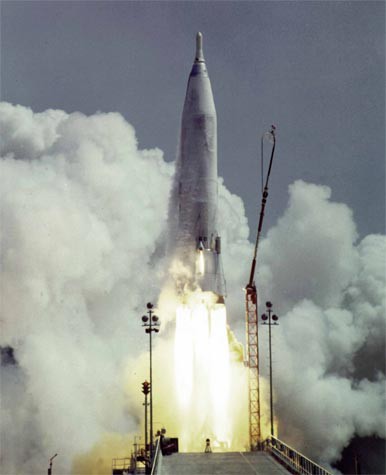
WASHINGTON, May 20, 1960 - The Air Force fired an inter-continental ballistic missile more than one-third the distance around the earth today in a deliberate but belated demonstration of United States missile prowess. An Atlas missile, fired from Cape Canaveral, Florida, at 11 A. M. Eastern Daylight Time, hurled a one-and-one-half-ton payload, simulating a hydrogen-bomb warhead, a record total of 9,000 miles into the Indian Ocean, southeast of the tip of South Africa. The flight took fifty-two and one-half minutes. The distance was not only the longest ever covered by a United States missile, but it also exceeded by more than 1,000 miles the greatest range thus far achieved by Soviet missiles. Ostensibly, the purpose of the flight was to test the Atlas missile, which is now coming into operational use, at "extreme ranges." The flight, however, was originally scheduled as much for psychological as for technical reasons. The launching had been planned for last week as part of a psychological strategy for a dramatic demonstration of United States military power in advance of the summit meeting. For technical reasons once because radio contact was lost with a tracking ship, and a second time because of a failure in the missile itself the launching had to be postponed. As a result, it finally came as President Eisenhower was flying home from a summit conference that collapsed over the flight of an American U-2 reconnaissance plane. Although it failed to achieve the originally desired psychological impact, the flight, by an unplanned historical coincidence, did provide a contrasting demonstration of the military and technological revolution being brought about by development of long-range ballistic missiles. It was thirty-three years ago today that Charles A. Lindbergh took off alone on his 3,610-mile trans-Atlantic flight that lasted thirty-three and one-half hours. Today, the missile payload, traveling at a top speed of 17,000 miles an hour, spanned two oceans and fell into a third in fifty-two and one-half minutes. The payload landed in a pre-selected target area in the Indian Ocean 1,000 miles southeast of Capetown, South Africa, and about 500 miles northeast of the British owned Prince Edward Islands. The United States had two planes and one ship in the impact area to warn shipping and aircraft away and to track the nose cone on its re-entry into the earth's atmosphere. No attempt was made, however, to recover the nose cone. The missile propelled a nose cone that will protect hydrogen warheads. The Air Force said the purpose of the test was "to obtain information and data on re-entry at increased velocities resulting from longer range flights." An Air Force announcement said "preliminary telemetry data indicates that all test objectives were achieved." The Air Force used the latest version of its first operational ICBM, the Convair manufactured Atlas D (Missile 56D). The 260,000-pound, seventy-five foot tall missile is powered by three rocket engines producing a total of nearly 400,000 pounds of thrust at take-off. As the missile left the launching pad, it rose nearly straight upward through a haze over the Florida coast and then tipped over and pointed in a south-easterly direction. As the missile stopped firing, the nose cone was detached and went soaring in a 1,000 mile high trajectory over the South Atlantic, passing off the nose of South America, off the tip of South Africa and into the Indian Ocean. Because of the earth's rotation during flight, the nose cone followed an S-shaped path on earth, thus permitting it to loop around the protrusion of South America and the tip of South Africa without passing over any land. When it finally plummeted to earth, the nose cone was traveling in an easterly direction. The exact aiming point, according to Air Force officials, was Lat. 38 degrees S., Long. 38 degreees E. Air Force officials said there was "every reason to believe this was a highly accurate shot,” but that it would probably take several days of analysis to estimate how close the nose cone came to the aiming point. The missile carried slightly more instruments than usual, but otherwise it was the same missile that has performed so successfully in test firings and that is now being installed at launching sites in this country. The nose cone was the same General Electric Mark III version that will be used on operational missiles. From a military standpoint, the firing was a demonstration that the Atlas could at least match Soviet missiles in range and could reach any target in the Soviet Union from bases in the United States. It was after the Soviet Union fired two multi-staged missiles 7,760 miles into the Pacific Ocean last January that the Air Force scheduled the long-range shot by the Atlas. Officials conceded that the Soviet missiles could undoubtedly match or exceed the Atlas distance record and because of their greater thrust could probably deliver a bigger warhead than that of the Atlas. Nominally, the Atlas is designed for a range of 6,300 miles which is sufficient to reach most targets in the Soviet from northern bases in the United States. The additional range, however, would have several military advantages in permitting the missile to reach more targets or to follow roundabout trajectories that would complicate an enemy's defense problems. Once a missile's range is extended to 8,500 miles, there is theoretically no limit to the distance it can travel. At this range, the missile has enough velocity to go to any point on earth, or, if aimed correctly, to go into orbit. One Atlas, the SCORE communications satellite that carried President Eisenhower's Christmas message in 1958, has already been placed in orbit. In today's firing, therefore, the Air Force had to strike a delicate balance in aim and velocity to make the missile go 9,000 miles instead of into orbit. To achieve the 9,000-mile range, the missile was given an extra burst of velocity, about 17,000 miles an hour instead of the normal rate of 15,700 miles an hour, by firing its rocket engines for a few additional seconds. The missile was also aimed at an angle that was slightly lower than normal, but not so low that it would go into U.S.Fires Atlas to Indian Ocean.
TopHome » Missiles » Squadrons » Documents » Photos » Videos » Sitemap » Search » What's New
Copyright © 2001- All Things Atlas Historical Center, Inc. All Rights Reserved.
