
SM-65 Atlas Inter-Continental Ballistic Missile System 1956-1965
Rocketdyne Corporation
Atlas Rocket Engine Provider
MA-2 Propulsion System

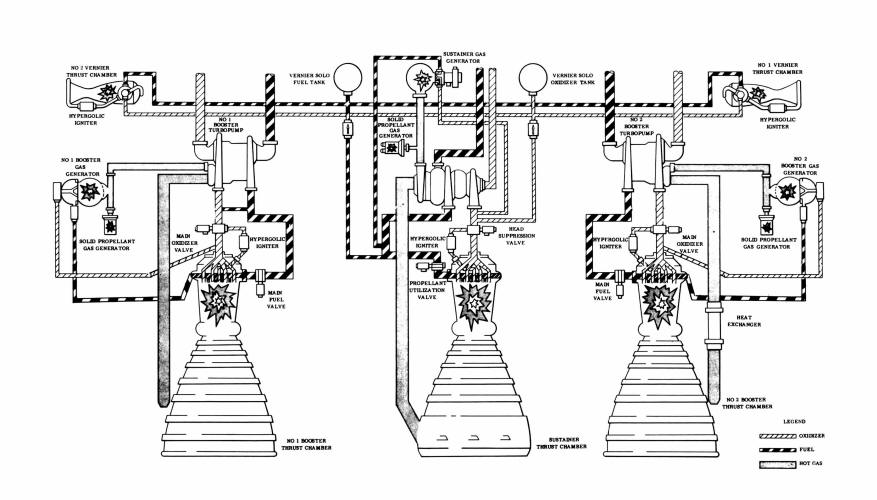
MA-2 Propulsion System Diagram
The Rocketdyne MA-2 was a liquid-propellant rocket propulsion system developed in the late 1950's for the SM-65 Atlas ICBM missile program. It represented an evolution from earlier prototypes, incorporating higher thrust and refined designs for operational use in intercontinental ballistic missiles and space launch vehicles.
Components
The MA-2 system featured a "stage-and-a-half" configuration, where all engines ignited at liftoff, and the booster section was jettisoned mid-flight after about two minutes. Key elements included: Two XLR89-5 booster engines: Each with its own turbopump but sharing a common gas generator for efficiency. One LR105-5 sustainer engine: Provided continued thrust after booster separation. Two LR101 vernier engines: Small thrusters for pitch, roll, and fine directional control, fed propellants from the sustainer's turbopump. The engines used regenerative cooling with brazed thin-walled thrust chambers, bell-shaped nozzles, and gimbaling for steering. Propellants were RP-1 (refined kerosene) fuel and LOX (liquid oxygen) oxidizer across all components.
Specifications
Booster Thrust (Combined): Approx. 309,000 lbs.
Sustainer Thrust: 58,000 lbs.
Vernier Thrust: 1,000 lbs.
Total Liftoff Thrust: Approx. 366,000 lbs. (Including Sustainer and Verniers)
Usage and History
Produced from 1958 to 1962, the MA-2 powered the Atlas D ICBM, which became the first operational U.S. ICBM deployed in 1959 with 30 units across four sites. It was also adapted for the Mercury-Atlas LV-3B launch vehicle, supporting NASA's Project Mercury manned orbital missions from 1962 to 1963, including four crewed flights (e.g., John Glenn's Friendship 7, Atlas 109D). Modifications for spaceflight included reliability upgrades like combustion instability baffles, redundant electrical systems, and a plastic LOX pump liner to prevent sparks. The MA-2 evolved into later variants like the MA-3 (simplified and uprated for Atlas E/F) and MA-5 (for heavier payloads in space launches). Its design influenced subsequent Rocketdyne engines, emphasizing staged combustion and cryogenic handling.
MA-3 Propulsion System
Rocketdyne MA-3 Engine System Diagram
The Rocketdyne MA-3 was a liquid rocket propulsion system developed in the late 1950s by North American Aviation's Rocketdyne Division (now part of Aerojet Rocketdyne). It served as an evolution of earlier Atlas propulsion packages like the MA-1 and MA-2, powering various models of the Convair SM-65 Atlas intercontinental ballistic missile (E/F ICBM) and its derivatives used for space launches. The system was key during the Cold War era for U.S. strategic deterrence and early space missions, including orbital launches with upper stages like Able, Agena and Centaur.
Components
The MA-3 integrated multiple engines into a single propulsion unit, using RP-1 (kerosene) fuel and liquid oxygen (LOX) as the oxidizer. It consisted of: Two LR-89 booster engines: These provided the primary liftoff thrust. Each was rated at approximately 150,000–165,000 lbf (667–734 kN) at sea level, depending on the specific variant (e.g., LR-89-NA-5 or LR-89-7). One LR-105 sustainer engine: This continued operation after booster jettison, delivering about 57,000–60,000 lbf (254–267 kN) of thrust at sea level (e.g., LR-105-NA-5 or LR-105-7). Two LR-101 vernier engines: Small roll-control thrusters, each producing around 1,000 lbf (4.45 kN), used for fine attitude adjustments during flight. The engines employed turbopump-fed systems with gas generators for pressurization, and the design allowed the boosters to be jettisoned mid-flight to reduce weight for extended range.
Differences from MA-2
The MA-3 was a simplified and more reliable iteration of the MA-2. Key improvements included independent turbopumps and gas generators for each booster engine, eliminating shared components that could cause single-point failures. This allowed the boosters to operate autonomously from each other and the sustainer, enhancing overall system robustness while maintaining similar thrust profiles. The MA-3 also incorporated manufacturing efficiencies for mass production during the Atlas missile buildup.
Usage and History
Military Applications: Primarily used in Atlas E and F ICBM variants, with deployments starting around 1959. These missiles were stationed in horizontal complexes and underground silos across the U.S. as part of nuclear deterrence strategies. Space Launch Vehicles: Repurposed for civilian and military space missions as the Atlas SLV-3 (Standardized Launch Vehicle), powering early NASA launches such as Ranger probes to the Moon, Mariner missions to Mars and Venus, and various satellites. It contributed to over 100 successful orbital insertions before being phased out in the 1960's for more advanced systems like the MA-5. Development Context: Rocketdyne drew from Navaho missile engine tech to accelerate Atlas development amid Cold War urgency. The MA-3 entered production around 1959, with assembly lines focused on rapid integration. Research facilities also studied its exhaust plume properties for performance optimization. The MA-3 represented a milestone in U.S. rocket technology, bridging missile and space applications with reliable, high-thrust propulsion. Its legacy influenced later engines like the RS-25 used on the Space Shuttle.
TopHome » Missiles » Squadrons » Documents » Photos » Videos » Sitemap » Search » What's New
Copyright © 2001- All Things Atlas Historical Center, Inc. All Rights Reserved.
